Tabernarius is from the Latin meaning tavern or innkeeper and I just like the sound of the word – sounds better than just plain “tavern keeper”. In the past, the local inn or pub was an important meeting place for the locals (albeit mostly men). It was often used as the venue for public meetings and inquests. In modern times pubs may be less popular and many have closed their doors for good in the last few years with the economics of running this type of business being a challenge and that too proves too much for many, particularly in rural areas. In my place, New Fishbourne there used to be three pubs, but now only one remains – the Bull’s Head – and this blog deals in particular with one licensee who may have been driven by economics to desperate and dishonest measures.
Louis Gould took over the licence of the Bull’s Head sometime between 1882 and 1890. The previous occupant, William Knight is listed in a Kelly’s commercial directory for 1882 and Louis is listed in the directory for 1890. In the directories that I have copies of, Louis is listed up to 1895 and in 1899, Thomas Jenner is listed as the licensee of the Bull’s Head. I haven’t had chance yet to narrow down the dates by looking through the licensing records, but the following may help identify why Louis gave up the pub.
Sussex Agricultural Express, 16th January 1893
I love reading old newspapers and as can be seen from the above article, that by 1893 Louis was earning a living as a fly proprietor and horse dealer. A fly was a type of horse drawn carriage and was for hire by fare-paying passengers similar to a taxi today. I am not certain whether Louis was also still running the pub at this point.
Louis seems to be on the downward spiral, because he is later listed in a calendar of prisoners dated 9th January 1896 having been sentenced to “four calendar months hard labour”. What was his crime? He was convicted of “Unlawfully and with intent to defraud his creditors within two months before the date of a certain Judgement obtained in the Queen’s Bench Division of the High Court of Justice against the said Louis Gould by William Burgess, on the 23rd September, 1895, which is still unsatisfied, remove one gig, one landau, and two horses, on the 6th September 1895.” He subsequently removed other items on the 7th September (two more carriages) and on the 15th of October removed 25 horse collars and two saddles.
The previous incumbent of the Bull’s Head, William Knight was a pillar of the local society – he is even mentioned in a newspaper article as having saved someone’s life. Louis Gould seems to have been somewhat different.
Levi Henry Nutbeem of New Fishbourne, Sussex is the man in question. Levi was baptised in Chiddingfold, Surrey in 1860 and spent his early life in Petworth, a town about 17 miles away from New Fishbourne where he is shown on the 1891 census as a “baker and confectioner”. I don’t know what prompted the move to New Fishbourne, but he appears in trade directories from 1899 up until at least 1938 (the latest directory I have available) in various combinations of baker with either grocer or post office. Perhaps he became aware of an opening in New Fishbourne and was looking to better himself – a baker is not listed specifically in any of the earlier trade directories for New Fishbourne.
The 1911 census summary places the baker’s shop very precisely between the Wesleyan Chapel and the Woolpack Inn – food for the soul, food for the body and food for mind all in a row. The Wesleyan chapel was demolished 1971 but the Woolpack is still there, although now in a more modern guise as it was rebuilt in 1937.
Levi Nutbeem and his wife Louisa (nee Soal) are listed in the 1911 together with three of their five children – their eldest son Albert Edward was an Insurance Agent and is enumerated as living next door. He also appears in a number of the trade directories mentioned above. Another son, Harold died in his middle teens.
Levi died in 1949 (preceded by his wife in 1948) and left £4079.25. Probate was granted to his son Albert Edward and daughter Louie.
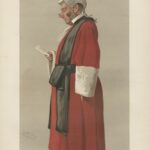
Sir Archibald Levin Smith (‘Judges. No. 24.’) by Sir Leslie Ward chromolithograph, published in Vanity Fair 3 November 1888 (NPG D44410)
Archibald Francis Lewin Smith was born in New Fishbourne and baptised at the parish church of St. Peter and St. Mary on the 29 September 1836. He was born into a far from humble family. His father Francis Smith was the local Justice of the Peace and the family lived at Salt Hill Park part of a large estate that consisted of many pieces of land in several parishes. Archibald was their only son and he had one sister.
Archibald Francis Lewin Smith went to Eton and then studied law at Trinity College, Cambridge obtaining a BA in 1858. He was a rowing ‘blue,’ in 1857, 1858, 1859. In 1859 ‘the race was rowed in a gale of wind, and the Cambridge boat filled and sank between Barnes Bridge and the finish…. Smith alone of the Cambridge oarsmen could not swim, and sat stolidly rowing until, when the water was up to his neck, he was rescued’.
He went on a career in the legal profession rising through the ranks to become a Justice of the Queens Bench, Justice of the High Court and eventually a Lord Justice of Appeals. He was also the Master of the Rolls. He was knighted in 1883.
He married Isobel Fletcher in 1867 and they had two sons, who followed their father into the legal profession. The family lived in Salt Hill Park (along with other residences) from at least 1887 until 1901. Archibald died in Knockando, Moray, Scotland in 1901. His wife preceded him by a couple of years.
So to give some background on his legal career. The Queens Bench was part of the High Court of Justice – the highest court in England and Wales (note that Scotland had a separate legal system even then) and responsible among other things for making case law that would be used to make judgements in the lower courts. A Justice of the High Court hears the more complex and difficult cases. Appeals judges deal with unfair verdicts, convictions and cases that were deemed not dealt with properly by either parties and a Lord Justice of Appeals again deals with the more complex or contentious cases. The Master of the Rolls is the second in seniority in England and Wales only to the Lord Chief Justice and also has an administrative responsibility for the management and the deployment and organisation of the work of the judges of the civil division (i.e. non-criminal cases)
So to end this piece – two pieces of entirely unrelated information.
According to Wikipedia, Archibald suffered from the pituitary disorder, acromegaly, which caused him to grow to nearly 7 feet (2.1 m) tall.
One of their servants at Salt Hill Park was my 3 x Great Grandmother and that because she married in New Fishbourne and raised a family there is one of the reasons that I started my One Place Study of New Fishbourne.

 Steve
Steve